Armistice Day: at Macron's last ceremony, the government clashes with teachers' unions
Emmanuel Macron is presiding over his last Armistice Day ceremony as head of state under the Arc de Triomphe this Wednesday. In the background, a row over a new mandatory school commemoration that unions accuse of militarising pupils.
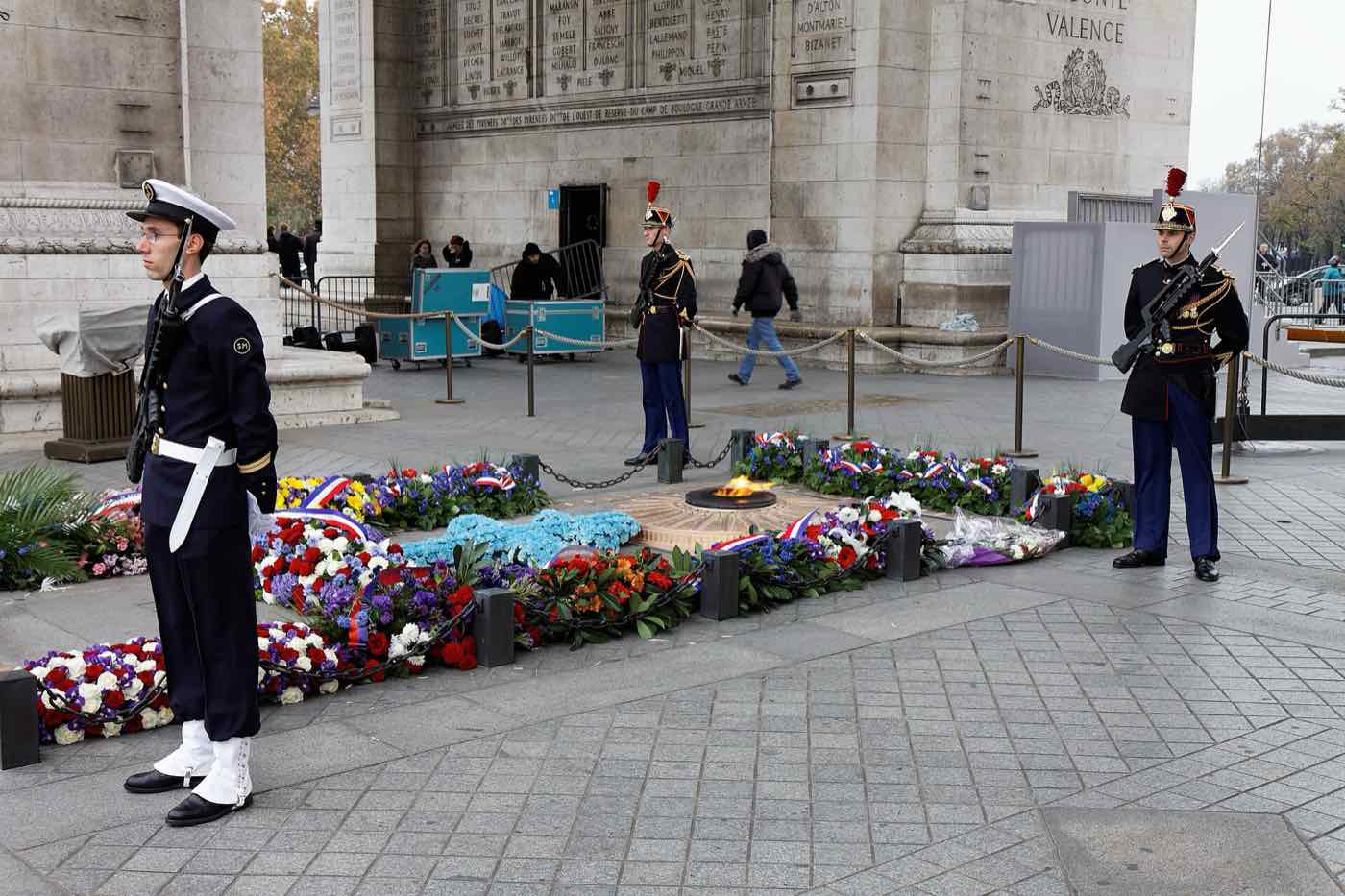
A final 11 November in office for Emmanuel Macron. The head of state is presiding this Wednesday morning, for the last time in his term, over the national ceremony marking the 108th anniversary of the 1918 Armistice: a wreath at the statue of Georges Clemenceau, then the rekindling of the Flame on the Tomb of the Unknown Soldier under the Arc de Triomphe at 11 am.
But the tribute is taking place amid tension. Not in the streets: in schools. And the government has chosen to go on the offensive.
A mandatory ceremony from age 9 to 18
The row stems from a circular published in early July. Since the start of the school year, it requires an annual ceremony paying tribute to all those who "died for France" for pupils from CM1, the fourth year of primary school, to the final year of high school. It must be held in schools within four days before or after 11 November.
The protocol, set out in an Education Ministry guide, includes the national anthem, a wreath-laying and the reading of the roll of the dead, after texts, songs or work prepared in class. Military personnel and elected officials may attend.
"War culture" versus "total disrespect"
Teachers have hit back hard. The Snes-FSU union speaks of an attempt at indoctrination. CGT Educ'ation argues that making the ritual compulsory turns remembrance into an exercise in obedience. Sud Éducation fears a risk of exploitation by politicians seeking to invite themselves into schools a few months before the presidential election. In one school near Paris, union branches passed a motion against bringing a culture of war into the classroom.
The history and geography teachers' association (APHG), more measured, recommends turning away any political representatives during the campaign and recalls the image rights of underage pupils.
The government is standing firm. On CNews, Armed Forces Minister Catherine Vautrin denounced what she called total disrespect for the memory of soldiers who died for France, adding that school is a place for sharing memory and learning citizenship. On TF1, Veterans Minister Alice Rufo called the row very regrettable, saying that 11 November is a celebration of peace. Acting government spokesman Mathieu Lefèvre said it was scandalous to criticise the school commemoration.
Education Minister Édouard Geffray played it down. On BFMTV and RMC, he said he had heard of no tension or refusal on the ground so far.
Lecornu in Vernon, Le Pen in Hénin-Beaumont
The day also has a campaign feel. Prime Minister Sébastien Lecornu is heading to Vernon, in the Eure department, his constituency. Marine Le Pen, the RN's presidential candidate, is attending the ceremony in Hénin-Beaumont (Pas-de-Calais).
In Paris, commemorations began at 9:10 am with a tribute to the high school and university students who demonstrated on the Champs-Élysées on 11 November 1940 against the Nazi occupiers. Around the Étoile, several metro and RER stations are closed and two security perimeters, with searches, are in place from 7 am to 2 pm.
School ceremonies can still be held until 15 November. Unions will be watching closely for the presence of elected officials in schools.